How to efficiently machine shaped parts on CNC mill-turn machines?


Gears, as vital transmission components, find extensive application across the entire mechanical field.
Technological advancements have increased rotational speeds and load capacities, which heightens the importance of operational smoothness.
At the same time, these advancements impose stricter structural requirements on gears.
The gear ring, as shown in Figure 1, represents a common configuration in mechanical gears.
Manufacturers often constrain the inner and outer diameter dimensions of the gear ring to ensure the strength of both the gear and its mating components.
This results in a relatively thin rim, The ratio of ring diameter to rim thickness often exceeds 15.
The inner ring features two symmetrical keyways for shaft connection.
To achieve proper fit between the ring and shaft, these keyways demand precise symmetry relative to the bore, resulting in poor ring stiffness and fatigue resistance.
During machining, this configuration makes the part highly susceptible to deformation.
This deformation causes tooth distortion, which disrupts load distribution and compromises component reliability and stability.
When the keyway on the ring gear engages with the shaft, significant tangential relative sliding forces exist along the inner tooth direction, generating substantial tangential forces.
Additionally, when the keyway contacts the key, the contact stress is substantial, causing premature keyway deformation and accelerated gear wear.
If different teeth exhibit varying depths of the carburized layer on the gear tooth surface, this also compromises the gear’s fatigue resistance.
Keyway gear rings that demand high machining accuracy, precise tooth surface roughness, and consistent carburized layer depth require special attention.
Therefore, manufacturers must ensure that the manufacturing process is particularly precise and controlled.
This underscores the necessity for a stable heat treatment method and precise positioning during keyway and tooth profile machining to ensure component fatigue resistance while enhancing production efficiency.
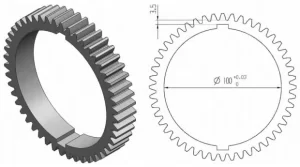
This paper examines a keyway-equipped thin-wall gear ring that manufacturers fabricate from high-quality carbon steel 12Cr2Ni4A.
It features an inner bore diameter of φ100+0.030, 48 teeth, a module of 2.5 mm, a pressure angle of 20°, and a tooth surface roughness of Ra 0.4.
The thinnest section of the gear ring measures 3.5 mm, The ratio of ring diameter to flange thickness reaches 29.8.
The keyway symmetry relative to the bore is 0.03 mm.
The part undergoes carburizing heat treatment, achieving a tooth surface hardness of 59–63 HRC and a core hardness of d = 3.1–3.55.
The gear precision grade complies with GB/T 10095.5-2022, Grade 6.
This thin-walled gear ring features two symmetrical keyways in its bore.
The gear teeth serve as the transmission mechanism, while the inner bore keyways provide the fixed connection.
Operating under high rotational speeds and heavy loads, these components impose stringent demands on manufacturing processes.
Deviations in dimensional and technical specifications can compromise the entire mechanical system’s functionality, reducing reliability and stability.
Therefore, manufacturers must develop a machining process for keyway-equipped thin-walled gear rings that ensures high precision, stable heat treatment, and minimal deformation.
The process must also suit mass production to guarantee consistent part performance.
AnalysisAnalyzing Figure 1’s structure and parameters: The keyway’s symmetry relative to the inner ring is 0.03 mm, the thinnest section of the gear ring is 3.5 mm, and the inner bore diameter is φ100+0.030.
The design requires high dimensional accuracy and positional accuracy.
Unlike conventional gear rings, the keyway-equipped gear ring exhibits a significant disparity between its radial dimensions and wall thickness—a ratio of 29.8 times.
Characterized by low rigidity and high hardness (≥HRC59), the turning stage necessitates a reference-first approach.
This ensures coaxiality between the bore and outer diameter, perpendicularity between the end face and bore axis, and parallelism between the two planes.
These conditions satisfy the positioning and precision requirements for rough machining of the gear.
Fixture design for finishing the bore is also critical to ensure a uniform grinding allowance after rough keyway insertion.
It also ensures even clamping force distribution, which minimizes deformation caused by mounting.
Additionally, manufacturers must select appropriate cutting conditions and optimize process flows and parameters.
They also need to arrange machining sequences and paths rationally to reduce deformation and minimize finishing keyway allowances.
This guarantees the precision grade of thin-walled gear rings while enhancing machining efficiency.
For high-precision gear rings, keyway and tooth processing requires a combination of rough and finish machining.
Rough machining typically employs hobbing or broaching, while finish machining uses gear grinding. Keyway roughing and finishing utilize broaching.
Controlling reference accuracy, carburized layer depth, and grinding allowance ensures uniformity in gear tooth surface carburized layer depth and surface integrity.
While other dimensions and technical requirements may meet standards, achieving consistent carburized layer depth remains a critical technical challenge in the industry.
The primary challenges encountered during actual machining include:
1) Overall structure: Thin-walled components are prone to deformation, making it difficult to guarantee the accuracy of internal bores.
2) Surface layer: Controlling the uniformity of the carburized layer depth on gear tooth surfaces is challenging.
3) Surface finish: Black skin phenomenon occurs on gear tooth surfaces after hobbing, and controlling the surface roughness Ra0.4 is difficult.
Manufacturers have comprehensively considered economic benefits, processing complexity, manual operation requirements, and equipment specifications.
This consideration has led them to develop tailored solutions for the aforementioned processing challenges.
These solutions work together rather than exclude one another, and the sections below outline the specific approaches.
Rough keyway insertion + stabilization treatment, grinding inner bore + precision machining of keyway and gear using inner bore as reference + stabilization treatment
Given the thin-walled structure of the part, keyway machining inevitably exacerbates deformation.
This paper innovatively employs a combination of rough and finish keyway insertion.
Additionally, manufacturers implement stabilization treatment between rough and finish insertion processes and use precision grinding as the reference.
By unifying the machining reference for keyways and gears, they effectively address the challenge of part deformation.Rough keyway insertion removes most of the stock.
Following stabilization treatment (low-temperature tempering for 2.5–3 hours at at 145±10°C, with low-temperature tempering initiated 0–3 hours after rough keyway insertion completion).
During fine insertion, dimensional corrections and technical conditions are applied.
The same reference is used for both keyway and gear tooth finishing, preventing geometric deviation caused by reference conversion.
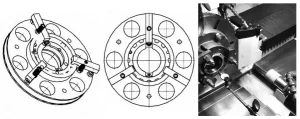
In Figure 2, the gear ring is positioned within the inner bore of the pitch circle fixture.
This bore is not circular but features three equally spaced micro-arcs distributed across its surface, each corresponding to an equal central angle.
Technicians uniformly place three locating pins (diameter 4.14 mm) within the tooth slots. Using the self-centering effect of the three micro-arcs, they rotate and secure the gear ring. You can conceptualize the three arcs as three arc-shaped notches.
When rotating the gear ring, the locating pins engage these notches for positioning. Subsequently, three clamping plates are used to secure the end face of the gear ring.
The inner bore of the gear ring is ground to serve as the reference for both the keyway and gear grinding.
This ensures consistency between the keyway and gear tooth reference surfaces, effectively maintaining the positional relationship between the keyway and teeth.
It also helps mitigate deformation caused by heat treatment, ensuring uniform material removal per tooth during gear grinding.
This guarantees consistent tooth hardness and carburization depth.
To ensure uniformity in the carburizing layer depth of gear teeth, the following methods are employed: controlling part precision prior to carburizing and minimizing part deformation during machining to reduce gear grinding allowances.
(1) Pre-carburizing precision control primarily maintains tooth thickness tolerance within 0.05 mm;
(2)To enhance fatigue resistance, engineers maximize residual compressive stress during machining and set the grinding allowance at 10%–20% of the carburizing depth.
(3) Tooth thickness tolerance is controlled within 0.05 mm.
Therefore, in process planning: – Gear grinding allowance is set at 0.15 ± 0.05 mm – Carburization layer depth during heat treatment is set at 1 ± 0.1 mm – Gear hobbing allows for 0.2–0.3 mm tooth profile protrusion
Through these dual controls, the minimum grinding allowance during gear grinding is 0.1 mm, and the maximum grinding allowance is 0.2 mm.
This ensures the carburized layer depth on the tooth surface is controlled while maintaining the required tooth profile protrusion.
(1) Black skin formation on gear surfaces after grinding stems from three factors: First, significant heat treatment distortion causes tooth deformation;
Second, after machining the two symmetrical keyways, the thinnest section of the gear ring measures only 3.5mm, reducing part rigidity and inducing overall irregular deformation.
Third, the grinding allowance is minimal at 0.15 ± 0.05mm.
Therefore, ensure that the grinding wheel is properly balanced before gear grinding to maintain optimal wheel performance.
During part clamping, guarantee the part’s bore is concentric with the machine’s two centers.
(2) To achieve surface roughness Ra0.4 during gear grinding, perform initial balancing of the grinding wheel before machining.
After precision dressing, rebalance the wheel to ensure stable grinding operation. Second, ensure rigid clamping of the workpiece.
Finally, before commencing gear grinding, run the machine idle for over 20 minutes to stabilize its operation before proceeding with gear grinding.
Manufacturers analyze the structural characteristics of the part and its technical and precision requirements.
Based on this analysis, they formulate the following process plan using the concept of “rough keyway machining + stabilization treatment, grinding the bore + precision machining of keyway and gear using the ground bore as reference + stabilization treatment”:
(1) Rough turning of the outer shape, which serves as the clamping reference for the next process.
(2) Finish turning the bore, which serves as the reference for gear hobbing.
(3) Gear hobbing, controlling tooth thickness tolerance within 0.05 mm. A tooth thickness allowance of 0.15 ± 0.05 mm is reserved for gear grinding.
(4) Chamfering and deburring: Gear profile processed to R0.5 ± 0.2, with remaining surfaces processed to R1 ± 0.5.
(5) Heat treatment, including carburizing and quenching, ensures the carburized layer depth on the tooth section is set to ±0.1 mm.
No carburized layer is present on other sections. Tooth surface hardness is 59–63 HRC, with core hardness d = 3.1–3.55.
(6) Internal bore turning: When using a CNC lathe with a three-jaw chuck to machine the tooth tip circle, apply moderate clamping force.
Before machining, align the bore runout to within 0.1 mm. When using a pitch circle fixture for part clamping, use the heat-treated tooth profile as the clamping reference (see Figure 2).
This process aims to eliminate deformation of the gear ring bore after heat treatment, thereby establishing the bore as the rough machining reference for keyway preparation.
(7) Rough keyway cutting: Before roughing, align the bore within 0.01 mm tolerance and allow machining allowance.
(8) Stabilization treatment (low-temperature tempering): Initiate low-temperature tempering 0–3 hours after rough keyway cutting nears completion.
Temperature: 145 ± 10°C. Holding time: 2.5–3 hours.
(9) Grind both end faces to design dimensions, ensuring parallelism within 0.015 mm and flatness within 0.01 mm.
(10) Stabilization treatment (low-temperature tempering). Low-temperature tempering begins 0–3 hours after completing end face grinding, at 145 ± 10°C for 2.5–3 hours.
(11) Grind the bore using a pitch circle fixture to clamp the part. Use the tooth profile as the clamping reference and the end face as the locating reference (see Figure 2).
Finish grind the bore to the design dimensions. This bore will serve as the reference for keyway finishing and tooth profile finishing.
(12) Stabilization Treatment (Low-Temperature Tempering): Low-temperature tempering begins within 0–3 hours after completing the internal bore grinding.
Temperature: 145 ± 10 °C. Holding time: 2.5–3 hours.
(13) Keyway Finishing: Before machining, align the bore within 0.01 mm tolerance. Machine the keyway to design dimensions.
(14) Stabilization Treatment (Low-Temperature Tempering): Low-temperature tempering commences 0–3 hours after keyway completion.
Temperature: 145 ± 10 °C. Holding time: 2.5–3 hours.
(15) Gear tooth finishing: Use a gear grinding machine with a tapered mandrel fixture. Single-side removal allowance: 0.15 ± 0.05 mm.
Process to GB/T 10095-5.1-2022 Grade 6 precision. Inspect for burn marks and ensure surface roughness Ra 0.4.
(16) Stabilization treatment (low-temperature tempering). Low-temperature tempering commences within 0–3 hours after gear grinding completion.
Temperature: 145 ± 10°C. Holding time: 2.5–3 hours.
(17) Polishing of tooth end face edges.
(18) Inspection.
(19) Surface treatment.
(1) Researchers conducted experimental studies on machining thin-walled gear rings with keyways.
Based on these studies, they developed an optimized manufacturing process using the concept of “rough keyway insertion followed by stabilization treatment, grinding the inner bore, then precision machining the keyway using the ground inner bore as reference, and finally gear stabilization treatment.”
This approach yielded a rational and feasible manufacturing process.
(2) Deformation issues in thin-walled gear rings with keyways were resolved.
During bore machining, a pitch circle fixture was designed for pitch circle positioning, effectively mitigating heat treatment-induced deformation.
This ensured consistent tooth removal allowance during gear grinding and enhanced positioning accuracy.
(3) Employed a three-step approach: controlling part accuracy before carburizing, managing deformation during machining, and regulating grinding allowance during final gear finishing.
This ensured uniform carburized layer depth on tooth surfaces and enhanced the part’s fatigue resistance.